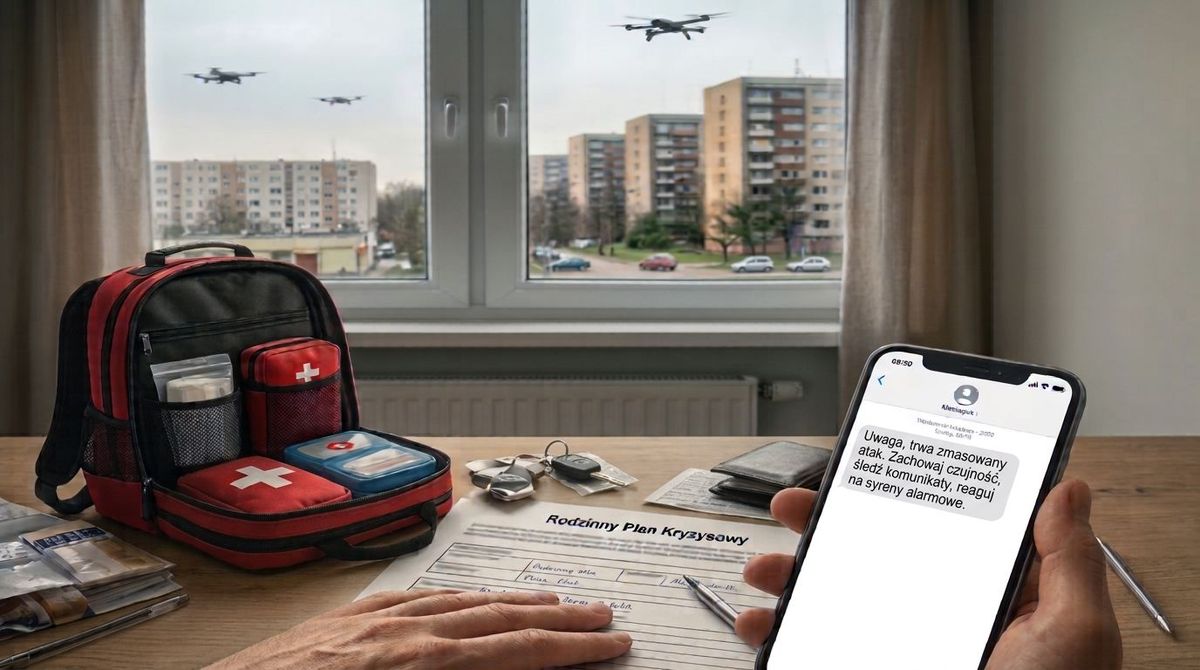

Why it matters to feel that we still have some control when things get difficult
Kinga Bigaj
When we go through a difficult period, the things we tend to notice most are stress, tension, sleep problems and difficulty concentrating. But there is something else that can affect how we cope: the sense that we have some control over what happens. We do not have to be able to change the entire situation. Sometimes it is enough to know that at least one thing remains in our hands.
Three studies, conducted several decades apart, illustrate this point. At first glance, it is difficult to see what they have in common. In one, researchers examined how people cope with noise. In another, they observed nursing home residents who were given the opportunity to make decisions about everyday matters. In the third, they studied dogs and rats under laboratory conditions. Each study focused on something different, but all of them help us understand how important it is to feel that our actions matter.
Noise and a button
In the early 1970s, David Glass and Jerome Singer studied how people respond to loud, unpleasant noise. Participants performed tasks that required concentration while being exposed to intense sounds. Among other things, the researchers examined whether noise was easier to tolerate when it occurred at predictable intervals, and whether having some control over when it stopped made a difference. [2. Glass and Singer, 1972]
They found that unpredictable noise had effects that continued even after the exposure had ended. Participants subsequently performed less well on tasks requiring concentration and persistence, such as proofreading a text or solving puzzles. [2. Glass and Singer, 1972]
The most interesting part, however, was an experiment involving a switch. Participants in one group were told that they could turn off the noise if it became too unpleasant, although the researchers added that they would prefer them not to use this option. Almost no one pressed the button. Even so, those who knew they could do so performed better on the subsequent tasks than participants who had no such option. [1. Glass, Reim and Singer, 1971]
The noise did not have to stop for something to change. It was enough to know there was a way to stop it. This finding illustrates just how much the mere sense of having some control can matter. It does not mean, however, that this sense protects us against every kind of stress. The study was conducted under specific laboratory conditions, and knowing that noise can be switched off is no substitute for actual safety or support in a threatening situation.
A plant on the windowsill
Several years later, Ellen Langer and Judith Rodin conducted a study in a nursing home in Connecticut. It involved 91 residents aged between 65 and 90, living on two similar floors of the facility. [3. Langer and Rodin, 1976]
On one floor, the director encouraged residents to make their own decisions. They could choose how to arrange their rooms, what to do in their free time and which activities to take part in. Each resident also received a plant of their choice, which they were responsible for looking after. [3. Langer and Rodin, 1976]
Residents on the other floor received a different message. The staff would look after their well-being, make the necessary decisions and water the plants assigned to them. This was a well-intentioned form of care, but it gave residents fewer opportunities to make decisions for themselves. [3. Langer and Rodin, 1976]
After three weeks, the residents who had been given more freedom and responsibility were more active, alert and engaged in social interactions. They took part in activities more often and rated their well-being more positively than those living on the other floor. [3. Langer and Rodin, 1976]
The study also had its limitations. It was conducted in a single facility. Although the two floors were randomly assigned to different conditions, residents were not individually assigned to the groups. Several aspects of everyday life were changed at the same time, so it is unclear which of them had the greatest impact on the results. [3. Langer and Rodin, 1976]
The study is also often cited as evidence that a sense of control can extend life. [4. Rodin and Langer, 1977] However, after a statistical correction published by the authors in 1978, the mortality difference turned out to be only marginally significant, and the authors themselves called for a more cautious interpretation. [5. Rodin and Langer, 1978] What matters more for our purposes is something else: the changes in the residents’ everyday functioning.
The residents did not gain control over illness, ageing or the rules governing life in the nursing home. What they did gain was more say in small, everyday matters. This was accompanied by greater activity and more positive assessments of their own well-being.
A theory that changed direction
The next story begins in the 1960s. At the time, Martin Seligman and Steven Maier were studying how previous experiences influence the behaviour of dogs in difficult situations. [6. Seligman and Maier, 1967]
The animals were divided into three groups. Dogs in the first group could stop an unpleasant stimulus by pressing a panel with their heads. Dogs in the second group received exactly the same stimuli, but their behaviour had no effect on when those stimuli ended. The third group had not undergone this procedure beforehand. [6. Seligman and Maier, 1967]
In the next stage, all the dogs were placed in a situation where they could avoid the stimulus by jumping over a low barrier. Most of the animals in the first and third groups quickly learned how to do this. Many of the dogs in the second group made no attempt to escape and remained passive. [6. Seligman and Maier, 1967]
This phenomenon became known as learned helplessness. For many years, it was explained as follows: animals that had previously experienced situations in which their actions made no difference learned that they had no control over what was happening. In subsequent difficult situations, they therefore stopped trying. The concept of learned helplessness became one of the important models used in research on depression.
In 2016, Maier and Seligman revisited these findings in a review of fifty years of research. They proposed a significant change in how the mechanism of learned helplessness should be understood. Neuroscientific research, conducted primarily on rats, suggested that passivity in response to prolonged unpleasant stimuli does not necessarily have to be learned. In the animal models studied, it is more accurately understood as a default response, associated, among other things, with activity in the dorsal raphe nucleus in the brainstem. [7. Maier and Seligman, 2016]
By contrast, in these animals the experience of control activates the medial prefrontal cortex, which helps inhibit this passive response. From this perspective, animals do not learn helplessness so much as learn to recognise that they can exert control over what happens to them. Moreover, previous experience of control may help them cope with later situations in which they can no longer influence how events unfold. [7. Maier and Seligman, 2016]
These findings concern mechanisms studied in animals. They cannot be directly applied to humans. Nevertheless, this shift in perspective is also important when we try to understand the behaviour of people going through a crisis. Passivity does not necessarily mean laziness, a lack of motivation or a conscious decision to give up. It may be a response to prolonged experience of feeling that our actions make no difference.
What do these three stories have in common?
Each of the studies described here focused on something different and was conducted under different conditions. They do not prove exactly the same thing. They do, however, share an important idea: it is easier to cope with a difficult situation when we feel that our actions can make a difference.
This is not about being able to control everything. In a real crisis, we often have no control over the threat itself. But we can make decisions about certain things: how we prepare, whom we ask for help, where we get our information and what we do in the coming hours. Not everything is within our control, but that does not mean we are powerless.
What does this mean in a crisis?
The importance of a sense of control is also reflected in recommendations for providing support after disasters and other traumatic events affecting large numbers of people. An international team of experts led by Stevan Hobfoll identified five essential elements of immediate and mid-term intervention after mass trauma: a sense of safety, calming, a sense of self- and community efficacy, connectedness and hope. Their conclusions were based on a synthesis of available evidence and expert consensus. One important aspect of supporting people after difficult experiences is therefore helping them regain a sense that they can take action and that their actions matter. [8. Hobfoll et al., 2007]
This knowledge is particularly useful when we are supporting others. Out of concern, we often want to do everything for someone going through a crisis. Yet even a small choice, such as asking what they need or where they would like to start, can help them regain a sense that something is still within their control. It is also worth remembering that passivity does not necessarily mean laziness or weakness. Regaining a sense of control takes time and sometimes requires the help of a psychologist or psychotherapist. We write about what to do and how to support others in a threatening situation in our article “Alarm: What to Do?”
In closing
The button in the noise experiment was almost never pressed. And yet, simply knowing that it could be pressed made a difference.
We are not always able to solve a problem, stop a threat or decide what happens next. But we can look for the areas in which we still have a say. Sometimes this will mean making a small decision, sometimes drawing up a concrete plan, and sometimes asking someone for help.
At the SOLIDA Foundation, we create tools designed to support people in exactly these situations: crisis guides and booklets, psychoeducational materials and digital tools. They are intended to help people prepare for difficult situations and identify possible ways to respond when those situations arise. They cannot remove the threat, but they can make it easier to find what is still within our control at a given moment.
References
1. Glass, D. C., Reim, B., and Singer, J. E. (1971). Behavioral consequences of adaptation to controllable and uncontrollable noise. Journal of Experimental Social Psychology, 7(2), 244–257.
2. Glass, D. C., and Singer, J. E. (1972). Urban stress: Experiments on noise and social stressors. New York: Academic Press.
3. Langer, E. J., and Rodin, J. (1976). The effects of choice and enhanced personal responsibility for the aged: A field experiment in an institutional setting. Journal of Personality and Social Psychology, 34(2), 191–198.
4. Rodin, J., and Langer, E. J. (1977). Long-term effects of a control-relevant intervention with the institutionalized aged. Journal of Personality and Social Psychology, 35(12), 897–902.
5. Rodin, J., and Langer, E. J. (1978). Erratum to Rodin and Langer. Journal of Personality and Social Psychology, 36(5), 462.
6. Seligman, M. E. P., and Maier, S. F. (1967). Failure to escape traumatic shock. Journal of Experimental Psychology, 74(1), 1–9.
7. Maier, S. F., and Seligman, M. E. P. (2016). Learned helplessness at fifty: Insights from neuroscience. Psychological Review, 123(4), 349–367.
8. Hobfoll, S. E., Watson, P., Bell, C. C., Bryant, R. A., Brymer, M. J., Friedman, M. J., et al. (2007). Five essential elements of immediate and mid-term mass trauma intervention: Empirical evidence. Psychiatry: Interpersonal and Biological Processes, 70(4), 283–315.