
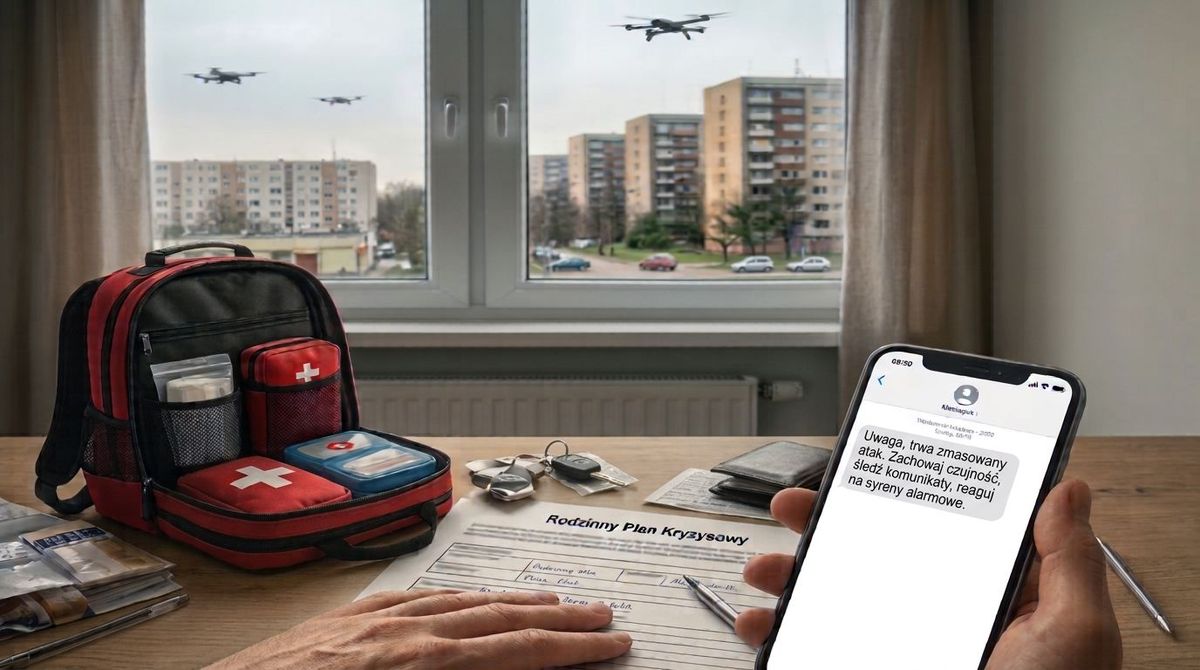
What happens in the mind, what to do, and how to support others during and after a threat from the air
Katarzyna Leszczyńska, Kinga Bigaj
1. When an Alert Comes Through
In September 2025, objects resembling drones breached Polish airspace. Residents of several regions received an RCB (Government Centre for Security) alert asking them to remain calm and to inform the authorities about any drones or the places where they had fallen [1. RCB, 2025]. In moments like these, one question naturally comes to mind: what should I do now?
In a threatening situation, we need to take care of our safety, understand what is happening, and think about our loved ones, all at the same time. This is not always easy, especially when fear sets in and it becomes difficult to think clearly. It is therefore worth knowing in advance what to do during an alarm, how to cope while sheltering, and what to pay attention to once the danger has passed. Preparing a few things ahead of time is also important.
In the boxes, we have gathered official recommendations from the relevant authorities. The rest of the text focuses on psychological responses to danger and ways of coping with them.
2. What Happens in the Mind During the First Few Minutes
People do not all react to sudden danger in the same way. Some experience intense fear, while others find their thoughts racing, lose their bearings, or struggle for a moment to believe what is happening. Numbness and difficulty carrying out even simple movements can also occur. These reactions may arise in response to a threat. In themselves, they are not signs of weakness or of an inability to cope.
Stress also affects the way we think. Acute stress can impair working memory and cognitive flexibility [2. Shields et al., 2016]. Research into the mechanisms of stress also suggests that even relatively mild but uncontrollable stress can disrupt the functioning of the prefrontal cortex, which plays a role in planning, working memory, and evaluating situations, among other things [3. Arnsten, 2009]. In practice, this means that during an alarm we may struggle to remember something that would normally come easily to us, or find it difficult to decide what to do first.
That is why it is worth preparing in advance. When an alarm sounds, we do not have to work everything out from scratch. We can rely on a plan we already know and adapt it to the current announcements and circumstances. The simpler the plan, the easier it will be to follow under stress.
3. During an Alarm
What the official guidelines say
• Warning signals. An alarm is announced by a modulated siren tone lasting three minutes. The all-clear is signalled by a continuous siren tone lasting three minutes. Announcements are also broadcast on radio and television, and in some places by text message [4. MSWiA, n.d.]. An RCB alert received on a mobile phone and a siren are two different ways of issuing warnings and alarms. In either case, read the message carefully and follow the instructions it gives.
• First steps. Stay calm and listen to announcements on local radio or television. Check that everyone in your household knows about the threat. If you are away from home, let your family know where you are [5. KP PSP Koluszki, n.d.].
• Finding shelter. If an accessible shelter point is nearby, the route is safe, and you have enough time to reach it, go there. If possible, take your emergency backpack and any essential medication. Use the stairs, not the lift. If reaching a shelter point would mean spending a long time outdoors, it is better to remain inside a building with solid, undamaged walls and ceilings [6. MSWiA, 2026a].
• The two-wall rule. If you cannot reach a shelter point, find a windowless room as close to the centre of the building as possible. At least two solid walls should separate you from the outside. An interior corridor, hallway, or walk-in wardrobe may be suitable. A bathroom is only appropriate if it has no window, boiler, or gas water heater [6. MSWiA, 2026a].
• What to avoid. Do not choose rooms with windows or balconies. Avoid places containing boilers, gas cylinders, large mirrors, or heavy objects hanging on the walls. Do not use basements or garages if their structure is damaged or if they present additional hazards, for example because of gas installations or the lack of a safe exit route [6. MSWiA, 2026a].
• If you are outdoors. If an explosion occurs and you cannot immediately reach a sheltered place, drop to the ground, preferably in a hollow or dip in the terrain, and cover your head [6. MSWiA, 2026a].
• Debris. Fragments of unidentified objects may be dangerous. Inform the authorities about drones or the places where they have fallen, but do not approach them [1. RCB, 2025]. Do not touch or move them.
• Photographs. The military has asked the public not to publish information or photographs showing troop movements or their locations [7. DGRSZ, 2022]. Taking photographs in such circumstances is simply not worth the risk.
Carrying out one task after another helps us focus on what we can do here and now. Instead of trying to make sense of the whole situation at once, we can concentrate on a specific action: taking the emergency backpack, going down the stairs, or checking whether our loved ones know about the alarm. This does not give us control over the threat itself, but it allows us to keep some influence over our own actions.
4. While Sheltering: How to Be There for Someone
Finding shelter does not mean that tension will immediately disappear. Waiting can be difficult, especially when we do not know how long it will last or what is happening outside. At such times, the presence of another person can make a real difference.
Hobfoll and colleagues identified five essential elements of early intervention following mass trauma: promoting a sense of safety, calming, a sense of self-efficacy and collective efficacy, connectedness, and hope [8. Hobfoll et al., 2007]. These principles can be applied in very simple ways when supporting someone who is going through a threat.
• Stay close and speak calmly. There is no need for lengthy explanations. Sometimes it is enough to say: “We have done what we can to find a sheltered place. I am here with you.” A calm voice and a slower pace of speech can help the other person focus on the conversation and make sense of the situation.
• Listen, but do not pressure. Psychological first aid recommends attentive listening without pressing people to talk about their experiences. It is also important to address their basic needs and help them stay in contact with other people [9. WHO, 2011]. Some people will want to talk, while others will prefer to stay silent. There is no need to change that.
• Do not dismiss the other person’s feelings or make promises you cannot keep. Saying “Don’t panic” or “Nothing is happening” is unlikely to help someone who is frightened. It is better to say: “You are scared, and that is understandable. We are doing what needs to be done right now.” Do not promise that nothing bad will happen either, because you simply cannot know that.
• Suggest small tasks. You could ask someone to hold a torch, check the water supply, or keep an eye on the radio. Such activities help direct attention towards something concrete. This applies to children and adults alike.
• Speak to children simply and honestly. Adapt your words to their age and avoid sharing details that might frighten them further. You could say: “We can hear the sirens, so we have taken cover in a sheltered place. I am here with you.” Closeness and physical contact, if the child wants it, may matter more than explanations.
• Pay attention to older people, those who are ill, and people with disabilities. If they are within reach, make sure they have their medication, glasses, hearing aids, and warm clothing. Remember their individual needs and the fact that they may need help with even simple tasks.
• Check information at its source. Official announcements from the authorities and the RCB are more reliable than messages passed from one phone to another. During a threat, it is easy to come across unverified information that only increases anxiety.
If you are already in a sheltered place but tension is still making it difficult to think, try focusing on just one thing. Place your feet firmly on the floor, pay attention to your breathing, or answer the person next to you. You do not have to deal with everything at once.
5. After the Threat: From Chaos to the Next Step
The all-clear does not necessarily mean that the tension is over. Often, it is only then that we begin to see how many things need attention. We may need to contact loved ones, check what is happening at work and at our children’s schools, deal with things at home, and cope with exhaustion after a sleepless night. Everything can seem equally urgent.
After intense stress, it can sometimes be harder to organise our thoughts and decide where to begin. Several problems, emotions, and uncertainties pile up on top of one another. This kind of mental chaos is not a psychological diagnosis. It describes a situation in which a person may feel unable to move forward.
Safety Comes First
Before turning to everyday matters, make sure there is no immediate threat to anyone’s life. Look out for whether anyone is injured, whether the building shows signs of damage, and whether you can smell gas. Do not enter a damaged building. If you suspect a gas leak, move to a safe place and call the emergency services on 112.
If someone talks about suicidal thoughts, take it seriously. Do not put off talking about it, and help that person get professional support. If their life is in immediate danger, do not leave them alone, provided you can stay with them safely, and call 112.
Six Questions to Help You Decide Where to Start
If the situation is now safe but you still find it difficult to decide what to do first, it may help to pause for a moment and answer a few questions. You can ask them of yourself or of someone who feels that everything is too much.
1. What is going on? Write down everything that is on your mind. Once it is on paper, it becomes easier to see what you are actually dealing with.
2. What is most urgent? What needs to be taken care of today? It might be contacting loved ones, taking medication, or informing your employer.
3. What can wait? Think about which matters do not need to be dealt with straight away and which can be postponed without creating additional risk.
4. What can I influence? What can I do myself, where do I need help, and what am I unable to change? I cannot influence whether the alarm will sound again, but I can find out where the nearest shelter point is.
5. Who can help? Think about family and friends, neighbours, the local authority, the emergency services, or professionals.
6. What is the next step? Choose one thing you can do first. It also helps to decide when you will do it: “After breakfast, I will sit down with my phone and call Mum first.”
Imagine someone who, after spending the night in a basement, writes that everything feels overwhelming. When they start listing their problems, it turns out there are five things: worry about their mother, who lives in another city; work; a child who refuses to go to school; a cracked window pane in the kitchen; and a lack of sleep. They could start by calling their mother. The window can be secured and reported later. A short message can be sent to their employer. The conversation with the child deserves more time, so it is worth coming back to it in the evening. None of these problems disappears straight away, but at least it becomes clear what to do first.
Not everyone needs this kind of help with organising things, however. Sometimes we know exactly what has happened and what needs to be done. We simply need someone to stay with us for a while.
6. Prepare in Advance
Some decisions are worth making before a threat arises. That way, when an alarm sounds, we do not have to think everything through from scratch.
The government’s Safety Guide includes, among other things, a template for a family emergency plan and a list of essential emergency telephone numbers [10. MON, MSWiA, RCB, 2025]. It is worth going through it together with loved ones and agreeing on a few basic things:
• where we will take shelter at home, at work, and at our children’s schools. The locations of shelter points can be checked on the gdziesieukryc.pl website or in the Gdzie się ukryć PL app, which also works without an internet connection. Shelter points are intended for the temporary protection of people. They are not the same as purpose-built protective structures, such as shelters. Some of them are made available only when a threat arises or an alarm is announced, so they may normally be closed [11. MSWiA, 2026b]. It is therefore also worth knowing where to take shelter inside the building where we happen to be;
• who will call whom and where we will meet if there is no phone connection;
• who will pick up the children and who will help older family members, people with disabilities, or neighbours who may need support;
• what is in the emergency backpack, including enough medication for several days.
The aim is not to prepare a plan for every possible scenario. What matters is that the people closest to us know where to find shelter, how to contact one another, and who is responsible for what. Such arrangements can prevent a great deal of unnecessary confusion when an alarm sounds.
7. When the Reaction Does Not Go Away
After a difficult event, people may experience anxiety, sleep problems, irritability, or recurring images of what happened. For many, these reactions gradually fade over time. But this does not always happen.
It is worth contacting a psychologist, a family doctor, or a crisis intervention centre if these reactions are very intense, persist, or grow stronger over time. Other signs that support may be needed include difficulties at work, with sleep, or with everyday responsibilities, and avoiding places or situations that bring back memories of the event. There is no need to wait several weeks. If you are already struggling, you can seek help now.
Where to Find Help
• 24-hour emotional support helpline for adults: 116 123.
• 24-hour Support Centre for people in a mental health crisis: 800 70 2222.
• Helpline for children and young people: 116 111.
• In an immediate threat to life: 112.
The numbers are given on the basis of information from the Polish Ministry of Health [12. Ministry of Health, n.d.].
References
1. Rządowe Centrum Bezpieczeństwa [Government Centre for Security] (10 September 2025). Alert RCB: neutralizacja obiektów (10.09) [RCB Alert: Neutralisation of Objects (10 September)]. https://www.gov.pl/web/rcb/alert-rcb---neutralizacja-obiektow-1009
2. Shields, G. S., Sazma, M. A., Yonelinas, A. P. (2016). The effects of acute stress on core executive functions: A meta-analysis and comparison with cortisol. Neuroscience and Biobehavioral Reviews, 68, 651-668. https://doi.org/10.1016/j.neubiorev.2016.06.038
3. Arnsten, A. F. T. (2009). Stress signalling pathways that impair prefrontal cortex structure and function. Nature Reviews Neuroscience, 10(6), 410-422. https://doi.org/10.1038/nrn2648
4. Ministerstwo Spraw Wewnętrznych i Administracji (MSWiA) [Ministry of the Interior and Administration] (n.d.). Alarmowanie i ostrzeganie [Alarms and Warnings]. https://www.gov.pl/web/mswia/alarmowanie-i-ostrzeganie
5. Komenda Powiatowa Państwowej Straży Pożarnej w Koluszkach [District Headquarters of the State Fire Service in Koluszki] (n.d.). Alerty i syreny na straży twojego bezpieczeństwa [Alerts and Sirens: Protecting Your Safety]. gov.pl. https://www.gov.pl/web/kppsp-koluszki/alerty-i-syreny-na-strazy-twojego-bezpieczenstwa
6. Ministerstwo Spraw Wewnętrznych i Administracji (MSWiA) [Ministry of the Interior and Administration] (2026). Instrukcja reagowania podczas zagrożenia atakiem z powietrza [Instructions for Responding to the Threat of an Air Attack] (published 25 September 2026). https://www.gov.pl/web/olioc/instrukcja-reagowania
7. Dowództwo Generalne Rodzajów Sił Zbrojnych (DGRSZ) [General Command of the Polish Armed Forces] (4 March 2022). Komunikat Dowództwa Generalnego Rodzajów Sił Zbrojnych [Statement by the General Command of the Polish Armed Forces]. https://www.gov.pl/web/uw-mazowiecki/komunikat-dowodztwa-generalnego-rodzajow-sil-zbrojnych
8. Hobfoll, S. E., Watson, P., Bell, C. C., Bryant, R. A., Brymer, M. J., Friedman, M. J. et al. (2007). Five essential elements of immediate and mid-term mass trauma intervention: Empirical evidence. Psychiatry, 70(4), 283-315. https://doi.org/10.1521/psyc.2007.70.4.283
9. World Health Organization, War Trauma Foundation, World Vision International (2011). Psychological First Aid: Guide for Field Workers. Geneva: WHO.
10. Ministerstwo Obrony Narodowej, Ministerstwo Spraw Wewnętrznych i Administracji, Rządowe Centrum Bezpieczeństwa [Ministry of National Defence, Ministry of the Interior and Administration, Government Centre for Security] (2025). Poradnik bezpieczeństwa [Safety Guide]. https://www.gov.pl/poradnikbezpieczenstwa
11. Ministerstwo Spraw Wewnętrznych i Administracji (MSWiA) [Ministry of the Interior and Administration] (2 November 2026). Aplikację Gdzie się ukryć PL możesz już pobrać na telefon [You Can Now Download the Gdzie się ukryć PL App to Your Phone]. https://www.gov.pl/web/mswia/aplikacje-gdzie-sie-ukryc-pl-mozesz-juz-pobrac-na-telefon
12. Ministerstwo Zdrowia [Ministry of Health] (n.d.). Gdzie uzyskać pomoc psychologiczną i psychiatryczną [Where to Find Psychological and Psychiatric Support]. https://www.gov.pl/web/zdrowie/gdzie-uzyskac-pomoc-psychologiczna-i-psychiatryczna