
How words and expectations shape what we actually experience
Jacek Schindler
Taste seems straightforward. We try a dish and know whether we like it. Pain works in much the same way: we feel it when something troubling is happening in our bodies. It is harder to believe, however, that a name, a description, or even a price tag could change how we experience something.
And yet we do not always perceive reality in the same way. Before we even taste a dish, our brains have already formed certain expectations. They give us an idea of what to anticipate and then compare those predictions with what we actually experience. As a result, information that initially seems insignificant can influence not only taste and enjoyment, but even our body's responses.
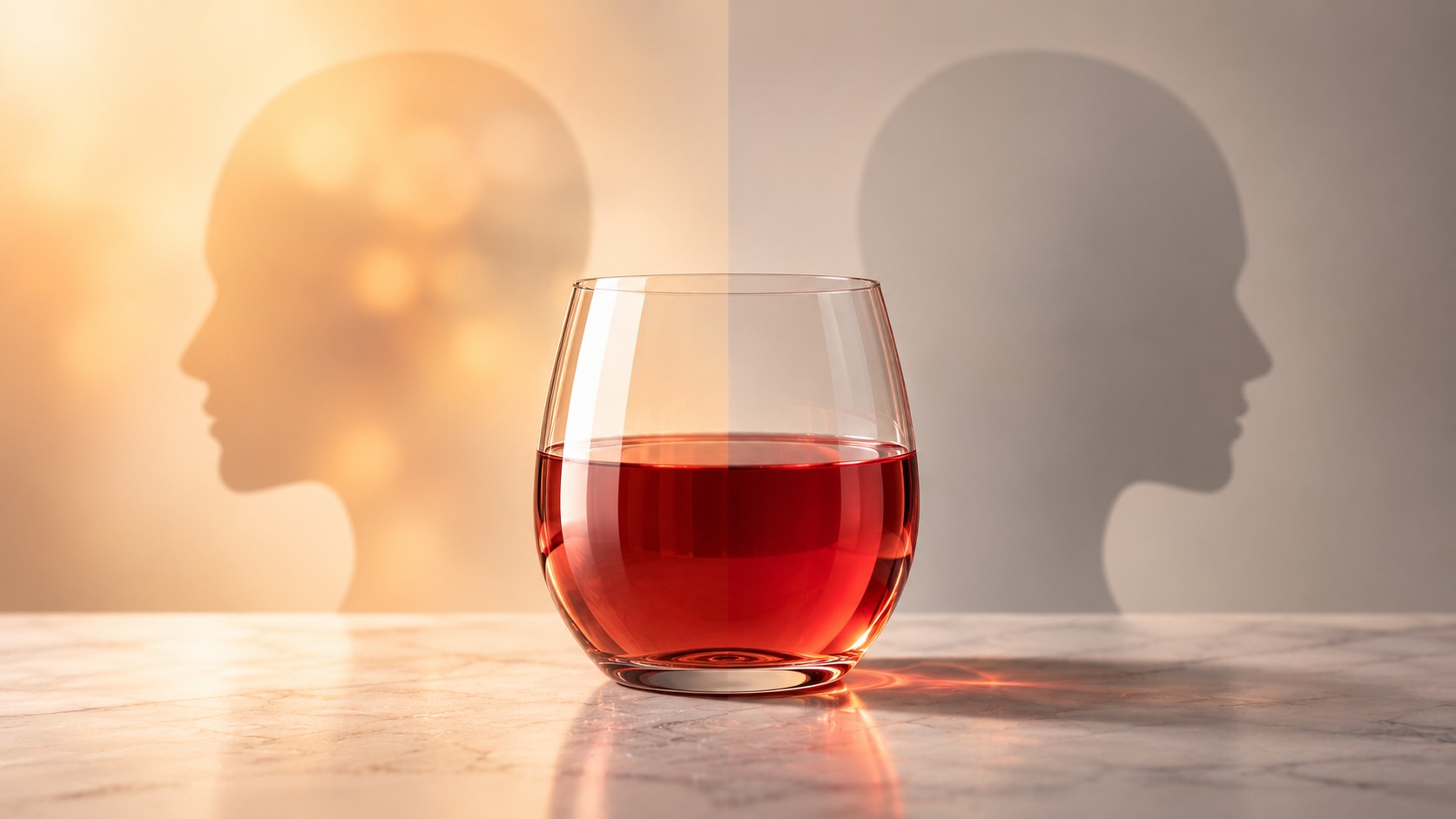
Does More Expensive Wine Taste Better?
In 2008, researchers from the California Institute of Technology and Stanford University invited twenty people to take part in a rather unusual wine tasting. The participants lay inside an MRI scanner and tasted Cabernet Sauvignon wines. They believed that each of the five wines was different and had its own price. In reality, there were only three different wines, and two of them were served twice, each time with a different price label. The same wine was labelled once as costing $90 and once as $10, while another was labelled once as $5 and once as $45. [4. Plassmann et al., 2008]
The results were interesting. The higher the stated price, the more enjoyable the participants found the taste of the same wine. Their ratings were not the only thing that changed. When the wine was presented as more expensive, the medial orbitofrontal cortex, a brain region involved in processing experienced pleasure, showed greater activity. This means that price information was associated both with a change in the participants' subjective evaluation of the wine and with brain activity accompanying the experience of tasting it. Naturally, the brain scans alone cannot tell us exactly what each participant was feeling. [4. Plassmann et al., 2008]
It is worth remembering that the study involved only twenty people, none of whom were professional wine tasters. They were not paying for the wine out of their own pockets either. We therefore cannot know whether the same effect would occur in every group or under different circumstances. Nevertheless, the study demonstrates something important: how we perceive a product depends not only on its actual quality, but also on what we expect from it.
Ice Cream That Didn't Taste Like Ice Cream
Information about what we are eating can also spoil the pleasure of a meal. Martin Yeomans and his research team, which included British chef Heston Blumenthal, discovered this when they prepared an unusual dessert: smoked salmon ice cream. It looked like ordinary pink fruit ice cream, but its taste was unmistakably savoury rather than sweet.
When participants were served the dessert as ice cream, their reactions were decidedly negative. Not only did they like it less, they also perceived it as saltier. The response was quite different when the same product was presented as a "frozen savoury mousse". Under that description, participants rated it much more favourably. [6. Yeomans et al., 2008]
In subsequent experiments, the researchers looked more closely at what might explain this difference. The word "ice cream" created expectations of something sweet, fruity, and creamy. When participants encountered a salty, fishy flavour instead, the disappointment was considerable. Interestingly, a neutral name that did not suggest what they should expect also led to acceptable ratings. [6. Yeomans et al., 2008]
In this case, expectations did not improve the experience. Quite the opposite: they made the flavour seem worse. When we expect a sweet dessert but are given something savoury, it can be difficult to enjoy it, even if the product itself is not necessarily unpleasant. [6. Yeomans et al., 2008]
One Milkshake, Two Labels
Expectations can influence more than just how we perceive taste. Alia Crum and her colleagues at Yale University decided to investigate whether information about food could also change the body's physiological response.
The study involved 46 people. Each participant visited the laboratory twice, one week apart, and drank the same 380-calorie milkshake on both occasions. Only the label changed. During one visit, the drink was presented as an indulgent 620-calorie milkshake. During the other, it was described as a light, sensible 140-calorie shake. [1. Crum et al., 2011]
The researchers took blood samples before showing the participants the label, after they had read it but before drinking the milkshake, and again after they had consumed it. They were interested in levels of ghrelin, a hormone associated with hunger that typically decreases after a meal. [1. Crum et al., 2011]
After drinking the milkshake presented as indulgent and filling, ghrelin levels dropped much more noticeably. When the same drink was described as a sensible, low-calorie option, levels remained almost unchanged. Yet the ingredients and calorie content were identical. The only thing that changed was what the participants knew about the drink. [1. Crum et al., 2011]
This does not mean, however, that participants simply felt fuller. There were no significant differences in how they rated the taste of the milkshakes or in their reported levels of hunger. What changed was the body's hormonal response. The study did not examine whether this effect lasted longer or influenced how much food participants ate later. It therefore cannot be treated as a way of controlling appetite. It does, however, show that beliefs about food can reach far beyond our subjective experience of taste. [1. Crum et al., 2011]
Dynamite Beets
If a name can change how we experience something, can it also determine what we choose to eat? Researchers at Stanford University explored this question in a university dining hall, where they observed diners' food choices over a period of 46 days.
Each day, one vegetable was featured. It was always prepared in exactly the same way, but described using one of four different labels. Beets, for example, were simply called "beets" on one day, and on others "lighter-choice beets with no added sugar", "high-antioxidant beets", or, much more enticingly, "dynamite chili and tangy lime-seasoned beets". The dining hall served an average of more than six hundred people at lunchtime. [5. Turnwald et al., 2017]
The differences were striking. The appealing descriptions led to 25% more people choosing the featured vegetable than the plain label, 35% more than the description emphasising health benefits, and 41% more than the wording that suggested restriction or sacrifice. [5. Turnwald et al., 2017]
The amount of vegetables taken by diners also changed. With the more appetising label, 23% more vegetables were taken than with the plain description and 33% more than with the restrictive one. However, the difference was not statistically significant when compared with the label emphasising health benefits. [5. Turnwald et al., 2017]
We often describe healthy food in terms of what it does not contain: less sugar, less fat, fewer calories. Such descriptions can nevertheless bring to mind the idea of deprivation. Perhaps sometimes it is better simply to say that something tastes good.
Placebo Without the Deception
For many years, placebo was associated mainly with a pill that patients could not distinguish from a genuine medication. This raised an ethical question: does someone have to be deceived in order to benefit from the placebo effect? A team led by Ted Kaptchuk at Harvard Medical School decided to find out whether that was really necessary.
The study involved 80 people with irritable bowel syndrome. Thirty-seven of them took tablets twice a day for three weeks. From the very beginning, they knew that the tablets contained no active ingredient and were similar to sugar pills. The packaging even carried the word "placebo". Patients were told that they did not have to believe the tablets would work. They simply had to take them regularly. The remaining 43 participants received no tablets, but had the same level of contact with the study staff. [3. Kaptchuk et al., 2010]
By the end of the study, 59% of those taking the placebo knowingly reported adequate relief from their symptoms. In the group that received no tablets, the figure was 35%. These were patients' own assessments, rather than objectively confirmed evidence that the illness had resolved. [3. Kaptchuk et al., 2010]
The researchers emphasised the importance of the broader treatment context. Taking a tablet regularly, knowing that one is participating in a treatment, and having contact with supportive staff may all have contributed to the results. However, the experiment cannot establish which of these factors was responsible for the improvement. What it does show is that positive effects associated with placebo can occur even when patients know exactly what they are taking.
What Does the Taste of Wine Have to Do with Stress?
Wine, ice cream, milkshakes, vegetables and pills. All of these examples show that our experiences are shaped not only by what we actually receive, but also by what we expect. A similar mechanism can be seen in the way we experience stress. Alia Crum and her colleagues described how people who believed that stress can be mobilising reported better well-being and functioning at work, and showed a moderate cortisol response in a stressful situation. [2. Crum et al., 2013] This does not mean that changing one's mindset is enough to make difficulties disappear. Not every stress response is helpful, and its meaning depends on what is happening and whether we realistically have a way of coping with the situation.
Similar knowledge matters when working with people in crisis. Psychoeducation is not about convincing someone that stress is good or that they should think positively. Rather, it is about explaining where their reactions come from and why they can be so intense. A pounding heart or racing thoughts after a difficult event are often an understandable response to what has happened. Knowing this does not take the suffering away, but it can reduce the additional fear that arises when we do not understand why we are reacting the way we do. That is why the way we talk to someone in a difficult situation matters so much: words can help them make sense of their own reactions, but they can also leave them feeling even more helpless.
In Conclusion
The same taste can delight us or disappoint us. A pill containing no active ingredient can bring relief, and a meal can trigger a different response in the body depending on what we expect from it. This does not mean that words can change reality at will. It does show, however, that the way we describe reality matters more than we might think.
It is worth paying attention to the words we use to describe our own experiences and other people's reactions. Not because we should always look for a positive interpretation, but because we should avoid adding unnecessary fear, disappointment, or guilt to our own lives or to the lives of others.
Sometimes, simply naming an experience differently can help us see it from a slightly different perspective.
References
1. Crum, A. J., Corbin, W. R., Brownell, K. D., & Salovey, P. (2011). Mind over milkshakes: Mindsets, not just nutrients, determine ghrelin response. Health Psychology, 30(4), 424–429. https://doi.org/10.1037/a0023467
2. Crum, A. J., Salovey, P., & Achor, S. (2013). Rethinking stress: The role of mindsets in determining the stress response. Journal of Personality and Social Psychology, 104(4), 716–733. https://doi.org/10.1037/a0031201
3. Kaptchuk, T. J., Friedlander, E., Kelley, J. M., Sanchez, M. N., Kokkotou, E., Singer, J. P., Kowalczykowski, M., Miller, F. G., Kirsch, I., & Lembo, A. J. (2010). Placebos without deception: A randomized controlled trial in irritable bowel syndrome. PLoS ONE, 5(12), e15591. https://doi.org/10.1371/journal.pone.0015591
4. Plassmann, H., O’Doherty, J., Shiv, B., & Rangel, A. (2008). Marketing actions can modulate neural representations of experienced pleasantness. Proceedings of the National Academy of Sciences, 105(3), 1050–1054. https://doi.org/10.1073/pnas.0706929105
5. Turnwald, B. P., Boles, D. Z., & Crum, A. J. (2017). Association between indulgent descriptions and vegetable consumption: Twisted carrots and dynamite beets. JAMA Internal Medicine, 177(8), 1216–1218. https://doi.org/10.1001/jamainternmed.2017.1637
6. Yeomans, M. R., Chambers, L., Blumenthal, H., & Blake, A. (2008). The role of expectancy in sensory and hedonic evaluation: The case of smoked salmon ice-cream. Food Quality and Preference, 19(6), 565–573. https://doi.org/10.1016/j.foodqual.2008.02.009